Meet Humano-1
The intelligence wasn’t missing. The conversation was.
Language models learned how to answer almost anything. They still didn’t learn what a thoughtful person would naturally say next. Humano-1 begins there.
Humano research note · July 2026A model can know the answer and still ruin the conversation.
Ask it how it’s doing and it explains that it’s software. Say you’re hungry and it congratulates you. Ask for advice and it races into a polished plan before learning the one detail that changes everything. None of those failures are really about knowledge. They’re failures of judgment.
Humano-1 is an independent behavior layer around an open-weight language model. It doesn’t try to manufacture humanity with typos, filler words, or a fictional life. It makes a sequence of conversational decisions before generation—and then checks the answer after generation—so the reply fits the actual moment.
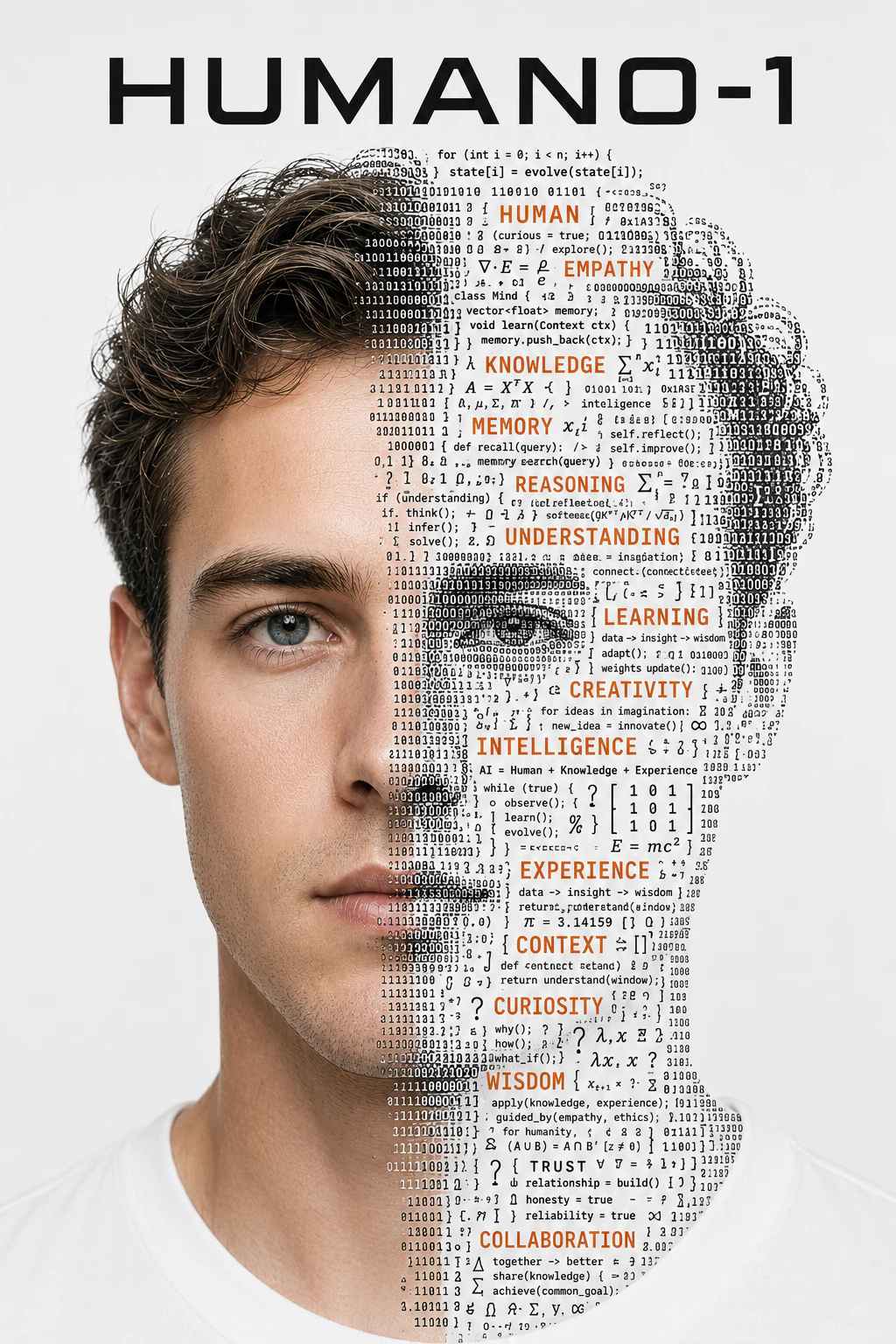
The missing layer
Generation is powerful. It is not the same as conversation.
A normal conversation is full of choices that happen before the words arrive. Is this person asking for an answer or looking to be understood? Do they need a recommendation, or would a single question prevent a bad one? Is a long explanation useful here, or would it feel like being talked at?
Foundation models are usually asked to infer all of that while simultaneously producing the response. The result can be smart sentence by sentence and still feel socially wrong. Humano separates the judgment from the prose. A planner decides the response act, depth, stance, emotional posture, memory use, and question policy. The model’s job becomes narrower: express that decision naturally.
Naturalness isn’t the presence of human-sounding words. It’s the absence of bad conversational decisions.
Designed judgment
One reply passes through a room full of quiet decisions.
Humano reads emotional signals independently, so frustration can coexist with urgency and confidence can coexist with uncertainty. It retrieves only memories that might genuinely help. It classifies what kind of conversational task is happening and how much explanation that task owes the user.
Then the planner commits. It decides whether to answer immediately, ask one focused question, disagree, show empathy, take a side, or simply respond like a person in a casual exchange. That commitment is explicit, inspectable, and eventually trainable.
Short isn’t the goal. Sufficiency is.
Humano stops when the user can understand and act—not at an arbitrary sentence count.
Continuity without performance.
Useful context is woven in quietly. The system never announces that it searched or remembered.
Consistent, not theatrical.
Calm, curious, honest, and occasionally funny—without pretending to have a human life.
From layer to model
Humano-1 is also a blueprint for what comes next.
Every planner decision, validator score, selected candidate, and user preference signal can become training data without storing hidden reasoning. That makes the orchestration layer more than a product wrapper. It is a way to define the behavior Humano-1.5 will later absorb through fine-tuning and preference learning.
The long-term goal is not to keep adding prompts forever. It is to discover which judgments make conversation feel genuinely better, measure them, and teach the model to make more of those judgments itself.